
What are the best windows in Boise for the weather? With hot summers and cold winters in Boise and the Treasure Valley, you want durable windows for your home for countless reasons!
Picture this – it is a January morning on the Bench, and you can feel cold rolling off the living room glass from six feet away. The furnace keeps running. That room never quite warms up. The best windows for Boise weather solve that, and the answer is narrower than any showroom will tell you: a U-factor at or below 0.22, a low-E coating that still lets winter sun through, and a frame that can survive our temperature swings. Triple pane?
For most Treasure Valley homes, it does not pay for itself. Here is what the numbers actually mean on your street.
What Boise’s climate does to a window
Our valley is a strange test for glass. Winters get genuinely cold, summers run hot and dry, and the swing between them is only half the story. Boise sits near 2,730 feet, which means homes here absorb roughly 10 to 15 percent more UV than they would at sea level, spread across more than 200 sunny days a year. That radiation degrades seals, gaskets, and frame material year after year.
Then there is the daily whiplash. A spring or fall day in the Treasure Valley can start at 22 degrees and reach 65 by mid-afternoon, and the valley runs through something like 120 to 130 freeze-thaw cycles annually. Every one of those cycles expands and contracts your window frames and the seals holding your glass together. Thousands of times over a window’s life.
Why does any of this matter more than it would in a mild climate? Because the Department of Energy puts windows at roughly 10 percent of a home’s surface area while accounting for 35 to 45 percent of its winter heat loss. In a heating-dominated climate like ours, the glass is where the money leaks out.
Understanding Window Ratings Table & NFRC Labels:
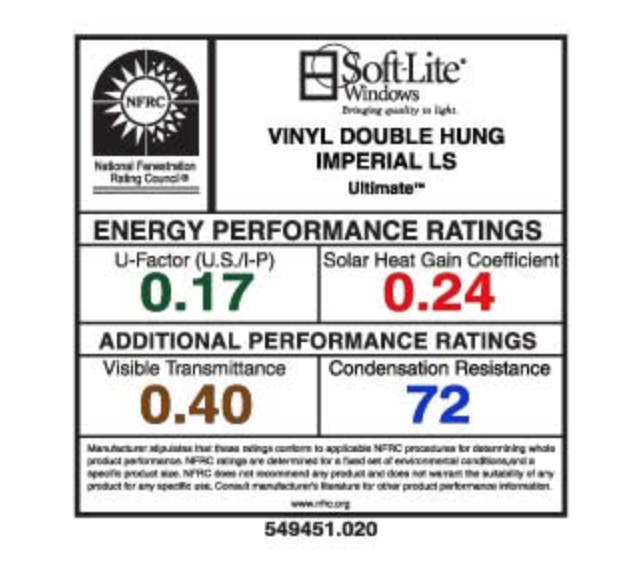
What do the window ratings mean, and does it matter if you live in Boise? Every new window carries an NFRC label, and shoppers tend to skim past it toward the color and the grid pattern. Learn to read two figures on that sticker, and you can evaluate any quote you get.
| Rating | What it measures | Target for Boise |
|---|---|---|
| U-factor | How much heat escapes through the window. Lower is better. | 0.22 or lower |
| SHGC | How much solar heat passes through the glass. | 0.17 or higher (see below) |
| VT | Visible light transmitted. Higher means a brighter room. | 0.40 or higher, personal preference |
| AL | Air leakage through the assembly. Lower is tighter. | 0.30 or lower |
Idaho falls in the ENERGY STAR Northern climate zone, which is heating-dominated and driven primarily by U-factor. Under ENERGY STAR Version 7.0, windows in the Northern zone need a U-factor of 0.22 or lower to qualify, tightened from the older 0.30 threshold. If a quote hands you a window at 0.30, it is a generation behind what your house needs.
Why “block the sun” windows is the wrong advice in Boise
This is the piece most window articles get backward, because they are written for a national audience and default to Southern-climate thinking. You have probably read that you want the lowest possible solar heat gain. That isn’t necessarily true in Boise and the Treasure Valley.
ENERGY STAR Version 7.0 introduced something new for the Northern zone: a minimum SHGC of 0.17. A floor, not a ceiling. The reasoning is straightforward once you sit with it. In a climate where you spend far more of the year heating than cooling, sunlight coming through your south-facing glass in January is free heat, and glass tuned to reject all of it makes your furnace work harder for no reason. The program even allows a tradeoff, where a slightly higher U-factor can still qualify if the SHGC is high enough to compensate.
So the goal in the Treasure Valley is not the darkest, most reflective glass on the shelf. It is a low-E coating tuned to hold heat in while still letting useful winter sun through. Ask for the SHGC number, and be skeptical of any salesperson pushing a heat-rejection package built for Phoenix.
Should every window in the house get the same glass?
Almost every quote the team here at Legacy Roofing has reviewed has specs for one glass package for the entire home. It is simpler to order and simpler to price. It is also leaving performance on the table, because your walls do not face the same conditions.
Here is what we recommend for custom windows in Boise:
- South-facing windows collect the most winter sun, so a higher SHGC here earns you free heat during the months your furnace works hardest.
- West-facing windows take the brutal end of a Boise summer afternoon, when the sun sits low and drives heat straight through the glass. Lower SHGC belongs here, and this is the elevation where people complain about faded flooring and rooms that will not cool.
- North-facing windows get little direct sun in either season, so U-factor is what matters. Spend your money on insulation value, not solar control.
- East-facing windows catch gentler morning sun and generally do fine with your standard package.
You do not need four different windows. Asking your contractor to spec at least two packages, one favoring solar gain and one favoring solar control, costs little and pays back every season. Most homeowners never think to ask.
5 Best Window Styles and Brands for Boise:
The best replacement window depends on your home’s exposure, budget, and existing openings. These five window lines offer dependable options for Boise and Treasure Valley homes when paired with the right glass package and professional installation.
1. Alside Mezzo Vinyl Windows
Alside Mezzo is our top choice for Boise homeowners because it combines a narrow vinyl frame, energy-efficient glass packages, optional foam-enhanced chambers, attractive styling, and excellent overall replacement value.
2. Pella Impervia Fiberglass Windows
Pella Impervia uses strong fiberglass frames that resist expansion and contraction during Boise’s seasonal temperature swings. Dual- and triple-pane glass options provide dependable comfort, efficiency, and long-term durability.
3. Marvin Essential Fiberglass Windows
Marvin Essential windows feature low-maintenance Ultrex fiberglass inside and out. Their structural stability, clean profile, and resistance to temperature-related movement make them well suited for Treasure Valley weather.
4. Andersen 100 Series Composite Windows
Andersen 100 Series windows use Fibrex composite material, providing greater rigidity than standard vinyl with low maintenance and modern color options. They offer a practical balance between affordability, appearance, and durability.
5. Milgard V400 Tuscany Vinyl Windows
Milgard V400 Tuscany windows offer a traditional vinyl profile, multiple operating styles, and Low-E glass options that help limit winter heat loss and reduce unwanted summer heat buildup.
Window performance can vary by size, operating style, and glass package. Before ordering, compare the complete NFRC ratings and select a configuration designed for Boise’s hot summers and cold winters.
Do the best windows for Boise weather need triple pane?
Usually not, and I will take some heat from the window industry for saying it plainly.
The performance gap is real but smaller than the price gap. High-performance triple-pane units land around 0.15 to 0.22 U-factor, while quality double-pane units run roughly 0.25 to 0.30, and a good double-pane package with low-E coating, argon fill, and a warm-edge spacer delivers close to 80 percent of the benefit at about 60 percent of the cost. Triple pane typically runs 30 to 50 percent more than comparable double pane, and the energy savings alone tend to take 12 to 18 years to earn that back, which is longer than most people stay in a house.
There are homes where triple glazing genuinely earns its keep:
- Your home has an unusually high window-to-wall ratio, so the glass dominates the envelope and every point of U-factor counts.
- Noise is a problem, near State Street, a busy arterial, or under the airport approach, where the third pane does more for sound than it does for your gas bill.
- This is your forever home and you are optimizing for comfort over payback math.
- You are chasing an ENERGY STAR Most Efficient rating, which requires a U-factor of 0.20 or lower and is essentially all triple-glazed.
For a typical Boise or Meridian home where the owner expects to move within a decade, I would rather put that upgrade money into a better frame and a meticulous installation. Those decide whether the window is still performing in year twenty.
Which frame survives our temperature swings?
Frame material matters more here than in a mild climate, and for one specific reason: movement. Fiberglass expands and contracts at nearly the same rate as glass, roughly five times less than vinyl. In a valley cycling through 50-degree days and 130 freeze-thaw events a year, that stability is what keeps the seal between frame and glass intact.
| Frame | Cost | Lifespan | Boise verdict |
|---|---|---|---|
| Vinyl (quality, multi-chamber) | Lowest | 20 to 35 years | Solid value if you buy a reinforced multi-chamber product, not builder-grade |
| Fiberglass | 10 to 30 percent above vinyl | 30 to 50 years | Best long-term match for our swings; seals last decades longer |
| Wood or wood-clad | High | 30 plus with upkeep | Beautiful, but our UV and dry air demand real maintenance |
| Aluminum | Low to mid | Long | Skip it for a heated home. Metal conducts cold straight through the frame |
Two practical cautions. Cheap vinyl is the product I pull out of Treasure Valley homes early, because thin, unreinforced frames lose their seal to expansion stress and the freeze-thaw cycling here shortens vinyl’s life by several years compared to a mild climate. And dark vinyl on a sun-hammered west elevation is asking for trouble, since vinyl softens at high surface temperatures and a dark frame in our UV runs hot.
Worth knowing regardless of what you buy: insulated glass units fail eventually, and foggy glass between the panes typically shows up somewhere between year 15 and year 25. That is a glass replacement, not a whole-window job, so do not let anyone talk you into replacing the entire unit over condensation.
The part of the window nobody sells you
Here is what the sticker cannot tell you. A window rated at 0.20 that is installed out of square, unshimmed, or stuffed with fiberglass batt instead of properly sealed, performs like a window rated far worse. Air finds the gap between the frame and the rough opening, and no glass package compensates for that.
“You can buy the best window made, and I can still install it badly enough to make it a bad window.” That is how one of our installers puts it to homeowners who are agonizing over glass specs while treating the labor line as interchangeable. The install is where the rating either becomes real or becomes marketing.
What a careful installation looks like: the opening gets flashed so water drains out rather than in, the window sits square and level and shimmed so the sash operates without racking, the gap around the frame gets low-expansion foam rather than compressed batt insulation, and the exterior gets sealed properly against wind-driven rain. None of it is glamorous. All of it decides if you feel a draft in January.
One decision inside the install deserves more attention than it usually gets. An insert replacement, sometimes called a pocket or retrofit window, drops a new unit inside your existing frame. It costs less, goes in faster, and leaves your trim alone, which makes it a reasonable choice when the old frame is genuinely sound. You do give up an inch or two of glass area on every opening, and it hides whatever is happening behind that frame. A full-frame replacement strips the opening back to the studs, which lets us see and correct rot, failed flashing, and missing insulation before the new window goes in. On older Boise homes where water has been finding its way past a windowsill for years, that is not an upsell. It is the only version that fixes the actual problem.
Best Advice for New Windows in Boise –
Recap for your quote, because the best windows for Boise weather come down to four calls: chase a U-factor of 0.22 or lower, insist on an SHGC of at least 0.17 so you keep free winter sun, ask for a higher-gain package on the south and a lower-gain package on the west, and choose the frame for our temperature swings rather than the lowest bid. Double pane with low-E, argon, and a warm-edge spacer serves most Treasure Valley homes better than a triple-pane upgrade you will not live long enough to recoup.
Have someone walk your house and note the orientation, condition, and exposure of every opening before you order anything, because that walk is what tells you which windows need the upgrade and which are fine as they are. Homeowners across Boise, Meridian, Eagle, Nampa, Kuna, Star, and Caldwell call us at (208) 901-1142 for that walkthrough and an itemized quote that lists the actual ratings, not just a brand name.
 The 8 Best Gutter Companies in Boise & The Surrounding Treasure Valley